The Story of the Grand Magal of Touba
A Day of Gratitude Born from Exile
Every year on the 18th of Safar, the second month of the Islamic calendar, millions of pilgrims travel to the holy city of Touba in Senegal for the Grand Magal. It is the largest religious gathering in West Africa, and for Mourides around the world it is the most important day of the year.
The Magal is not a celebration of victory, wealth or conquest. It commemorates the day Cheikh Ahmadou Bamba Mbacké, founder of the Mouride path, left home to face arrest and exile by the French colonial administration. He spent more than seven years in Gabon. What looked like his defeat became, in his own words, the source of his greatest spiritual favors. The Magal is the community’s answer to his request: to thank God for them every year.
The word màgal comes from Wolof and means “to glorify” or “to honor.” Cheikh Ahmadou Bamba chose the name himself so that the day would be devoted to glorifying God and His Prophet (peace be upon him) for the blessings they had bestowed.
The Departure: 18 Safar 1313 (1895)
By the 1890s the Cheikh’s teaching had drawn thousands of disciples, and the colonial authorities grew suspicious. Slanderers and jealous rivals told them he was preparing a holy war. The authorities summoned him several times. He did not answer because, as his biographer Serigne Bachir Mbacké writes, he was waiting for an order from his Lord and from the Prophet. A detachment of troops was sent to bring him in.
When the order came, the Cheikh took leave of the Prophet, who placed a spiritual “wall of protection” around him. He described it in his own verses:
“The Chosen One (peace be upon him, his family and companions) has set around me a barrier that keeps all harm away, and he told me: ‘Go, and fear no deception.'”
On Saturday, 18 Safar 1313 AH (August 1895), Cheikh Ahmadou Bamba left the residence he had built in the Djolof for learning and spreading knowledge. That evening he met the colonial officer at Djéwol. A disciple who was there, Cheikh Banji Ndiaye, said the small party had no water and the Cheikh’s ewer was empty. A stranger appeared carrying a full waterskin, filled their vessel and vanished. The Cheikh used the water for his ablutions, since he never resorted to dry ablution (tayammum).
The Cheikh later recalled meeting the officer:
“After the Asr prayer, the commander of the colonial troops came to speak to me. But I turned away from him, turned to God, and recited the Basmala fifty times. This softened his ardor and calmed his fury.”
Trial in Saint-Louis and the Night in Dakar
He was taken to Saint-Louis, then the colonial capital. He spent the last ten days of Safar and the whole month of Rabi’ al-Awwal there under heavy guard. During that time he finished and revised his poem on the names of the warriors of Badr. Chiefs of the Ndiambour region offered to plead his case. He declined: “Leave me to my Lord, who is more compassionate toward me and knows better what is good for me.”
He then appeared alone before the colonial Privy Council. When the accusations were read, he answered:
“Bring your informant, for if he were present, the truth would be known at once.”
The Cheikh later said the council members argued over three options: house arrest in Saint-Louis, execution, or deportation. House arrest was rejected for fear that his disciples would flock to him, and execution was ruled out. Deportation was adopted unanimously. He saw God’s hand in that verdict:
“God inspired those who had arrested me with the idea of exiling me to distant lands, where I nevertheless obtained great favors.”
He was driven to Dakar and locked overnight in a dark, hot, foul-smelling cell. He spent that night reciting the second and third chapters of the Qur’an and sending blessings on the Prophet, and he said his night “became peaceful once more.”
Embarkation for Gabon
On Friday, 1 Rabi’ al-Thani 1313 (September 20, 1895), the Cheikh boarded a steamship bound for Gabon. The ship lay at anchor through Friday and Saturday night. A group of disciples led by Mame Cheikh Ibrahima Fall came aboard to say goodbye in tears.
A visitor urged him to write to the new governor, declare his innocence and ask to be released. The Cheikh picked up his pen, but after one line he heard a voice:
“Do you dare complain to a creature like yourself instead of to Me?”
He erased the line and wrote nothing more.
The Seven Years of Trial
In Gabon (Libreville, Mayumba and the island of Mayumba), Cheikh Ahmadou Bamba endured hardship, isolation and humiliation. Mouride tradition tells of many trials during these years, and of his patience, prayer and steady devotion to God through all of them. He kept writing poems in praise of the Prophet.
He returned to Senegal in November 1902 as a figure of near-legendary standing. His spiritual community had grown rather than collapsed. Further exiles and surveillance followed: Mauritania (1903–1907), Thiéyène in the Djolof, and Diourbel from 1912 until his death in 1927. In total he spent about 33 years in exile or under watch.
He always taught that the exile was a gift, not a defeat. He said that before his deportation he had already reached the rank of the great sheikhs in Islam, Iman and Ihsan. Three goals still remained to him: perfect knowledge of God, perfect certainty, and arrival at God. He added that these “were only realized through my stay among those colonials.”
“Let Those Who Rejoice in My Joy Give Thanks”
Because the exile brought him such favors, the Cheikh asked his disciples to mark the anniversary of his departure every year with thanksgiving to God. In his own words:
“As for the favors God has granted me, my gratitude alone can no longer cover them.”
His invitation was that anyone who shared his joy in God’s favors should join him in giving thanks on that day. He asked that the gratitude be expressed through acts of devotion that follow the Sunna, and through sharing food.
In 1927, shortly before his death, he instructed his disciple Serigne Moulaye Bousso to sacrifice a sheep every 18 Safar and share the meat.
From a Family Gathering to Millions of Pilgrims
After Cheikh Ahmadou Bamba died in July 1927, his eldest son and first Khalife, Serigne Mouhamadou Moustapha Mbacké, held the first large gathering in Touba in 1928. Its purpose was to honor the founder’s memory.
Under the second Khalife, Serigne Mouhamadou Fallou Mbacké, the celebration took its modern form in the late 1940s. Sources give 1946, 1947 or 1948. He set the date on 18 Safar, as the Cheikh had wished, and invited the whole Mouride community to Touba. The Grand Magal has grown ever since:
- About 70,000 people attended in 1928.
- Nearly 2 million attended around 2000.
- More than 3 million attended in 2011.
- According to Senegalese organizers, more than 6.5 million attended in 2025, the 131st edition, held on August 15, 2025 under the Khalife General Serigne Mountakha Mbacké.
Because the Magal follows the lunar calendar, its date on the Western calendar moves about eleven days earlier each year.
How the Magal Is Celebrated
- Pilgrimage to Touba: Pilgrims arrive by road from all over Senegal and the region, and by air from Europe, the United States and elsewhere in Africa.
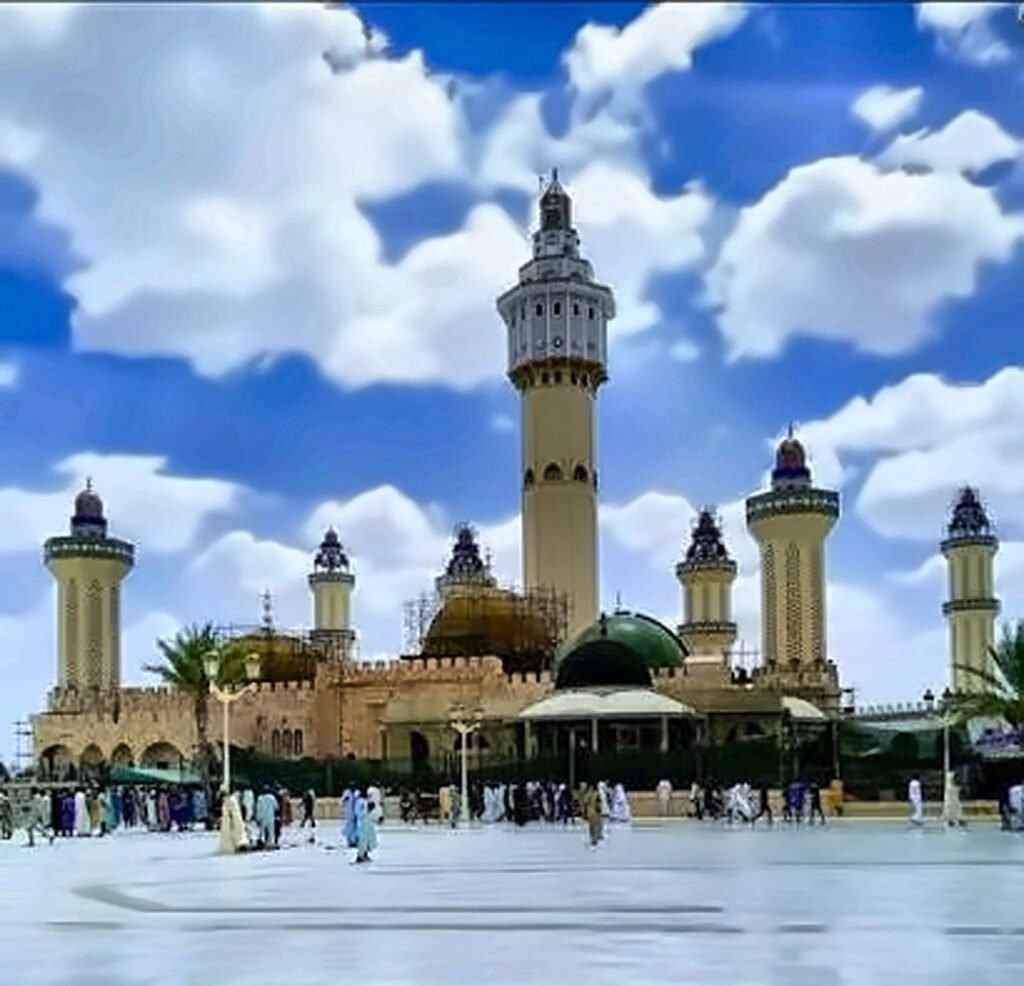
- Visits (ziyara): Pilgrims pray at the Great Mosque and at the mausoleum of Cheikh Ahmadou Bamba. Many wait for hours for a few moments of prayer there.
- Recitation of the Khassaids: Day and night, groups recite the Qur’an and the Cheikh’s poems, his Khassaids.
- Berndé (hospitality): Families and dahiras slaughter cattle, sheep and camels and feed every guest for free. No pilgrim goes hungry in Touba during the Magal.
- Audience with the Khalife: Delegations visit the Khalife General, who receives official delegations from the government and gives a message to the nation.
The Magal in the Diaspora
Mouride communities abroad mark the 18th of Safar in their own cities with prayer, Khassaid recitations, conferences and shared meals. This is how the Dahira Miftahul Khuyor Wal Maram – Touba Cincinnati observes the Magal: by gathering in gratitude, sharing hospitality and remembering the sacrifice and patience of Cheikh Ahmadou Bamba.