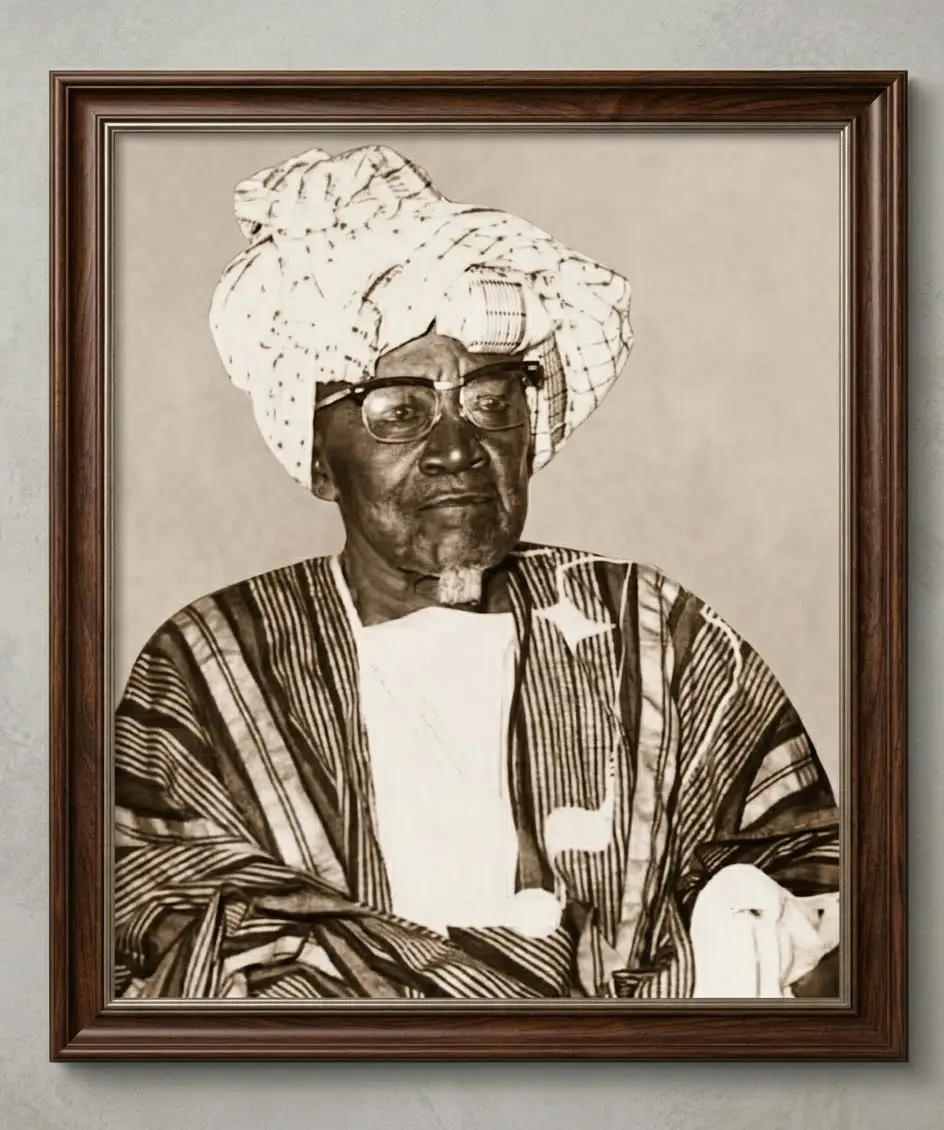
Cheikh Mouhamadou Fadel Mbacké (Serigne Fallou): The Second Khalife of Serigne Touba (1945–1968)
Birth: a night of blessing
Cheikh Mouhamadou Fadel Mbacké, better known as Serigne Fallou, was born around 1888 in Darou Salam. Tradition holds that he came into the world on the 27th night of the lunar month of Rajab, the night that recalls the Prophet’s Night Journey. Cheikh Ahmadou Bamba saw in this child a special destiny. To this day, the Mouride community celebrates his birth each year during the festival of Kazu Rajab.
His mother, Sokhna Awa Bousso, came from a family of eminent scholars that had given several imams to Touba.
A childhood devoted to knowledge
At the age of eight, he began learning the Holy Quran under Serigne Ndame Abdourahmane Lo. His paternal uncle, Mame Mor Diarra Mbacké, then taught him theology.
He became a master of Arabic, poetry, calligraphy and Quranic recitation (tajwid). Out of devotion, he copied the Quran by hand many times and offered these copies to his father.
At his father’s side in exile
When Cheikh Ahmadou Bamba was deported to Mauritania, the young Mouhamadou Fadel followed him there, together with his elder brother, Cheikh Mouhamadou Moustapha, and other disciples. Far from home, he continued to receive his education directly from his father. He is remembered above all for his total submission to his spiritual guide.
A pilgrimage in his father’s name
In 1928, his elder brother, then Khalife, entrusted him with an important mission: to perform the pilgrimage to Mecca, a wish that Cheikh Ahmadou Bamba had not been able to fulfill in his lifetime. Serigne Fallou accomplished this sacred journey on his father’s behalf.
Khalife of the Mourides
On July 13, 1945, after the passing of Cheikh Mouhamadou Moustapha, Serigne Fallou became the second Khalife général of the Mourides. He would lead the community for 23 years.
Under his leadership, the Grand Magal was celebrated in Touba in 1947. It has since become one of the largest religious gatherings in West Africa.
Completing the Great Mosque of Touba
As soon as he became Khalife, Serigne Fallou made the Great Mosque his first priority and sped up the work, faithful to the rule set by Cheikh Ahmadou Bamba: no outside funding. The construction was financed by the disciples alone, through their offerings (adiya) and through fields such as Touba Bogo, whose harvests went entirely to the building.
On June 7, 1963, he inaugurated the Great Mosque of Touba in the presence of President Léopold Sédar Senghor. He also established Quranic schools inside the mosque and instituted the daily recitation of the Quran there.
The builder of modern Touba
Serigne Fallou transformed Touba into a true city:
- city planning: in 1959, he launched the official division of Touba into planned lots;
- water: he had wells dug and water pumps installed;
- electricity and roads: he brought electricity to the city and improved the roads linking it to the rest of the country;
- commerce: he created the Ocass market, now one of the largest commercial centers in Senegal;
- villages and daaras: he founded or developed agricultural and educational villages such as Ndindy (founded in 1913), Madinatou Salam, Alia and Mbeppe, which remain places of learning and spiritual life.
A man of warmth and generosity
Serigne Fallou is remembered as a warm and welcoming man, generous to all, with a gift for comforting those who came to him. He was known for his kindness, his wit, and his mercy toward people in difficulty. Many disciples attribute blessings and healing to his prayers.
Return to God and legacy
Serigne Fallou returned to God on August 6, 1968, in Touba. His younger brother, Serigne Abdoul Ahad Mbacké, succeeded him as the third Khalife.
More than half a century later, his legacy stands in every minaret of the Great Mosque, in the streets of Touba, and in the hearts of millions of disciples. He remains the Khalife who completed the promise made in exile, and who turned Touba into the living city it is today.